LIFE Timber For All promotes a session in Santiago on NEB methodology and timber construction in Spain
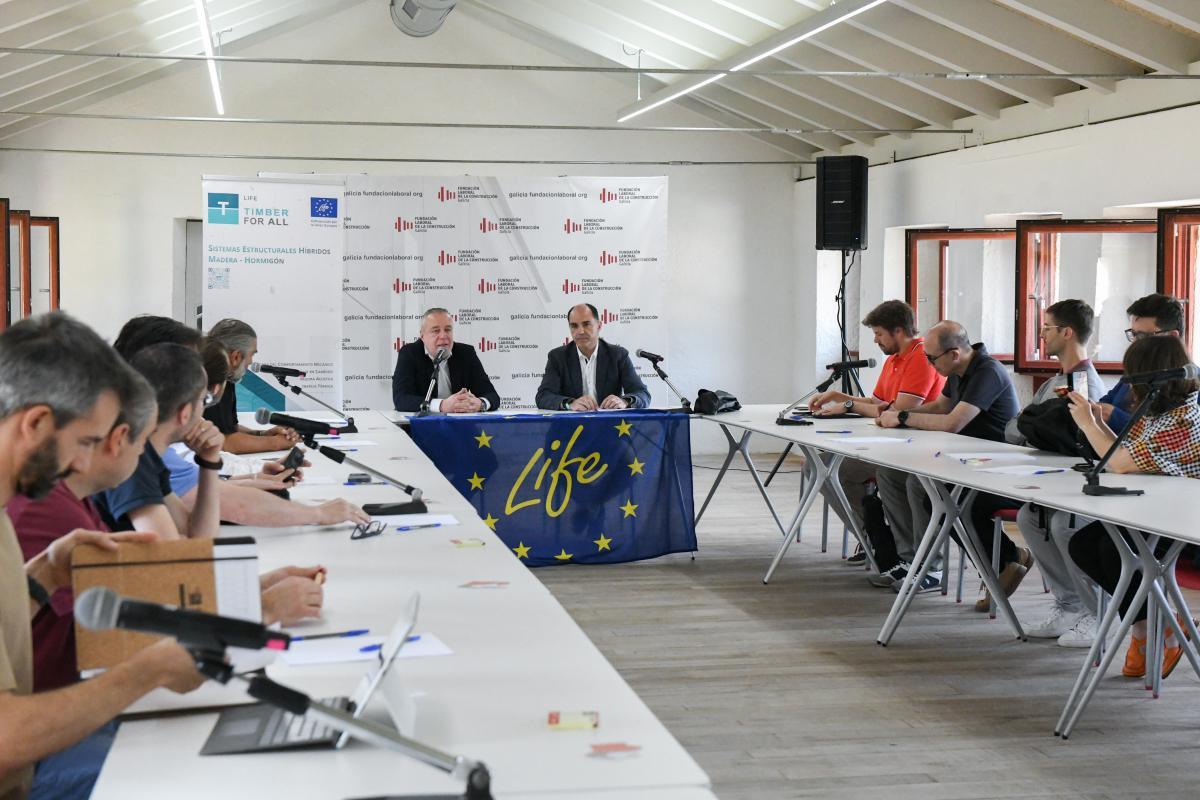
On Monday, 22 June, the headquarters of the Fundación Laboral de la Construcción in Santiago de Compostela hosted the session “NEB Methodology and Timber Construction in Spain”, a meeting aimed at opening a structured conversation with key stakeholders in the sector around a central challenge: adapting the methodological framework of the New European Bauhaus (NEB) to the context of industrialised timber construction in Spain.
The session, designed as a hybrid format combining a round table and a working workshop, made it possible to identify barriers, opportunities and reference cases that can contribute to defining a useful, applied methodology aligned with the reality of the sector. The event was coordinated by IAAC, a facilitating organisation and a benchmark in the field of the NEB Academy, which introduced the working framework and guided the conversation throughout the morning.
A methodology applied to the reality of timber construction
The working session was structured around the three main principles of the New European Bauhaus —sustainability, beauty and inclusion— applied to timber construction. The aim was to analyse how these axes can be translated into operational criteria to promote more responsible and innovative building with a positive impact on the territory.
The block dedicated to sustainability addressed issues such as environmental performance, traceability, circularity, carbon, forest management and other fundamental aspects for advancing towards truly responsible timber construction.
The reflection on beauty focused on architectural quality, spatial experience, wellbeing, the biophilic dimension and new design opportunities linked to the use of timber.
The inclusion block, in turn, enabled discussion on accessibility, affordability, public value, territorial cohesion and the capacity of timber construction to generate a positive social impact.
The session concluded with a shared discussion on the applicability of the methodology, possible development formats and the next steps for joint work within the framework of the project.
Galicia, a benchmark territory for timber construction
The institutional opening included the participation of Manuel Guaita, director of PEMADE, and Alfredo Fernández Ríos, director general of the Axencia Galega da Industria Forestal (XERA), who highlighted Galicia’s potential in the use of timber in construction. Fernández underlined the efforts of stakeholders in the forestry-timber sector and the commitment of the regional administration to promoting the use of this material in buildings developed in the community.
During their speeches, they emphasised the role of timber as a local resource with the capacity to generate industrial employment, added value and new opportunities around more sustainable architecture. They also highlighted the importance of projects such as LIFE Timber For All, involving research and innovation entities, companies and clusters with the aim of contributing knowledge, advancing the industrialisation of construction and strengthening its sustainability.
In this regard, it was recalled that the project focuses, among other lines of work, on hybrid timber-concrete systems and the development of low-carbon concrete through the use of ash. Progress in these materials is strategic so that companies can access solutions based on their own developments.
Reference cases and technical visits
In addition to the working session, the event included several technical presentations linked to specific experiences in construction innovation.
One of the presentations focused on timber-concrete solutions at the Galicia Proton Therapy Centre, with the participation of Daniel Hermosilla, from Rodiñas, and José Antonio Lorenzana, from PEMADE.
Next, Ángel Panero, from the Consorcio de Santiago, presented the rehabilitation works at the former Pontepedriña de Arriba tannery, followed by a technical visit to the site. In the afternoon, the programme was completed with a guided visit to the Moaña Health Centre.
Participation of project partners and sector stakeholders
Among the entities attending the event were project partners such as PEMADE, XERA, Rodiñas, Xilonor, IAAC, ITeC, the Clúster da Madeira e o Deseño de Galicia (CMD), Galicia Construye, the University of Granada and 3edata.
The meeting also included the participation of representatives from other organisations, sector companies and architecture professionals, as well as the presence of SERGAS as a guest entity.